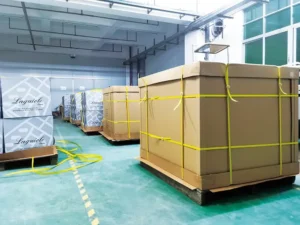
Struggling with getting your retail displays to market? You've designed a brilliant display, but now it's stuck in logistical chaos1, facing delays and retailer fines. The complexity of the supply chain is turning your launch into a nightmare.
Third-party logistics (3PL) services are the solution for assembling, packing, and shipping your retail-ready displays to major retailers like Walmart and Costco. A specialized 3PL partner handles everything from pack-out and palletization2n](https://mcintyredisplays.com/blog/pallet-displays-for-bulk-products/)%%%FOOTNOTE_REF_3%%% to labeling, ensuring your displays arrive on time and meet strict retailer compliance requirements4, avoiding costly chargebacks.

Getting your product onto the retail floor is a huge win, but it’s a process filled with potential pitfalls. I’ve seen fantastic display campaigns stumble right before the finish line because the logistics weren’t planned out. The journey from the factory to the store shelf is just as critical as the design of the display itself. A small mistake in pallet height or a missing label can lead to entire shipments being rejected. This is where a deep understanding of 3PL for retail displays becomes your secret weapon. Let’s break down how to navigate this crucial part of your supply chain to ensure your displays arrive perfectly every time.
What Is 3PL—and Why Retail-Ready Displays Depend on It?
Feeling overwhelmed by the logistics of your retail displays? The intricate process of getting your displays from the factory to the retail floor can be a major headache. Without the right support, you risk delays and non-compliance issues.
A Third-Party Logistics (3PL) provider that specializes in retail displays manages the entire process for you. They handle the assembly, kitting, warehousing, and transportation of your displays, ensuring they are prepared and delivered according to strict retailer guidelines. This partnership is essential for a smooth and successful in-store launch.

For retail-ready displays, a 3PL isn't just a warehouse; it's a critical partner in your marketing execution. Unlike general warehousing that focuses on storing goods, a 3PL for Point of Purchase (POP) displays5 provides specialized services like assembly, product pack-out, and creating retail-compliant shipments. They have the expertise and resources to manage the unique demands of displays for major retailers. I remember a client who tried to manage their own display fulfillment to save money. They ended up with significant chargebacks from a major retailer6 due to incorrect pallet configurations. A good 3PL partner understands the specific requirements of each retailer, from pallet height to label placement, preventing these costly errors. They ensure your displays are not just stored, but are actively prepared for the retail environment, making them an indispensable part of your supply chain.
How 3PL Manages Pack-Out for Cardboard POP Displays?
Wondering how your products actually get into the displays and ready for the store? The pack-out process7 can seem complex, with many moving parts and opportunities for error. Getting it wrong means your displays might not even make it to the sales floor.
The pack-out process7, managed by a 3PL, involves assembling the display and arranging the products within it. This critical step ensures that your display is not only visually appealing but also stable and ready for shipment, meeting all retailer specifications for a seamless transition to the store floor.

The pack-out strategy is a crucial decision point in the logistics of your cardboard displays. You have a few options, and the right choice depends on your product, display design, and budget.
Pack-Out Options
| Method | Description | Best For |
|---|---|---|
| Knocked Down Flat (KDF)8 | Displays are shipped flat with products sent separately. Assembly and pack-out happen in the store. | Lower shipping costs, but relies on store execution. |
| Pre-Packed/Assembled9 | Displays are fully assembled and packed with products at the 3PL facility before being shipped to the retailer. | Ensuring compliance and perfect presentation. |
| Half-Assembled | Displays are partially assembled by the manufacturer to simplify the final steps for the 3PL or store staff. | Balancing shipping costs with ease of assembly. |
I've found that pre-packed displays, while having higher initial freight costs, often result in a better ROI. This is because they guarantee the display is set up correctly and is immediately ready for the sales floor, minimizing reliance on busy store employees. For a large campaign with a corrugated floor display (FSDU), we opted for a pre-packed solution. The 3PL assembled the displays, loaded the products, and shipped them to the retailer's distribution center. The result was a near-perfect compliance rate and a successful promotion.
Palletization Rules That Make or Break Retail Acceptance?
Worried your perfectly packed displays will be rejected at the retailer's dock? Incorrect palletization3 is a common and costly mistake. A single error can lead to entire shipments being turned away, causing delays and financial losses.
Palletization involves arranging your packed displays onto a wooden pallet according to strict retailer guidelines. These rules cover everything from pallet size and height to how the load is secured. Adhering to these standards is non-negotiable for acceptance at major retailers like Walmart and Costco.

Palletization is a science, and retailers have perfected it to ensure safety and efficiency in their distribution centers. For instance, most big-box retailers in the U.S. mandate a standard 48" x 40" pallet.
Key Palletization Standards
- TI/HI: This refers to the number of boxes per layer (TI) and the number of layers high (HI). A proper TI/HI calculation10 ensures a stable and secure pallet.
- Pallet Height Limits: Retailers have strict maximum height requirements for pallets. For example, a Costco pallet display should generally not exceed 58 inches in height, including the pallet itself.
- Weight Distribution: Heavier items should always be placed at the bottom of the pallet to create a lower center of gravity and a more stable base.
- No Overhang: Products should not hang over the edge of the pallet, as this can cause damage and instability.
- Stretch Wrap and Protection: The entire pallet must be securely wrapped, and corner protectors are often required to prevent damage during transit.
I once worked with a brand that had their pallet displays rejected by Costco because the height was off by just two inches. This seemingly small error caused a major delay in their product launch and resulted in costly rework fees. Understanding and strictly following each retailer's specific guidelines is absolutely critical.
Labeling, Barcodes, and Compliance for Walmart & Costco?
Confused by the maze of labeling requirements for major retailers? Incorrect labels and barcodes are a surefire way to get hit with compliance fines and chargebacks. Each retailer has its own set of rules that must be followed precisely.
Retail compliance for labeling involves using specific barcodes and label formats, such as the GS1-128 and SSCC labels, to ensure your shipments can be tracked throughout the supply chain. Meeting these requirements is essential for selling your products in major retail stores like Walmart and Costco.

For retailers like Walmart and Costco, data is king. Their entire logistics system relies on accurate and scannable labels. Any deviation can bring their automated systems to a halt, resulting in manual handling and, you guessed it, fees for you.
Essential Labeling Components
- GS1-128/UCC-128 Labels11: These are the standard shipping labels used in the retail industry. They contain critical information about the shipment in a standardized format.
- Serial Shipping Container Code (SSCC)12: This is a unique 18-digit number that identifies each pallet or shipping container. Walmart requires an SSCC-18 on every pallet.
- Global Trade Item Number (GTIN): This is the barcode for the actual product being sold.
- Advanced Ship Notice (ASN)13: This is an electronic data interchange (EDI) document that is sent to the retailer before the shipment arrives, detailing the contents of the shipment.
I’ve learned that it’s best to work with a 3PL that has a proven track record with the specific retailers you’re targeting. They will have the systems and expertise to generate compliant labels every time. For one of our clients shipping to Walmart, their 3PL integrated directly with Walmart's system to generate the SSCC labels and ASNs, ensuring a seamless and compliant process.
China Manufacturing → U.S. 3PL: How the Workflow Really Works?
Curious about the journey your displays take from the factory in China to a U.S. retailer? Understanding this complex workflow is key to planning your timelines and budget. A misstep at any stage can lead to significant delays and cost overruns.
The workflow begins with manufacturing in China, followed by ocean freight14 to the U.S. The displays are then transported to a 3PL facility for assembly, pack-out, and final preparation for shipment to the retailer's distribution center. Each step requires careful coordination to ensure a smooth and timely process.

Here’s a step-by-step breakdown of a typical workflow for a cardboard display manufactured in China and fulfilled by a U.S. 3PL:
- Design and Manufacturing: It all starts with a design that is not only visually appealing but also optimized for shipping and assembly. We work with our clients to create displays that can be shipped efficiently, often flat-packed, to reduce freight costs.
- Ocean Freight: The flat-packed displays are loaded into a container and shipped from China to a U.S. port. This is the most time-consuming part of the journey and requires careful planning.
- Customs and Drayage15: Once the container arrives in the U.S., it must clear customs. After that, a drayage company transports the container from the port to the 3PL’s warehouse.
- Receiving and Inspection at the 3PL: The 3PL receives the shipment, inspects the displays for any damage during transit, and enters them into their inventory management system.
- Assembly and Pack-Out: This is where the magic happens. The 3PL’s team assembles the displays and packs them with your products according to the agreed-upon specifications.
- Palletization and Labeling: The packed displays are then palletized and labeled to meet the specific requirements of the target retailer.
- Final Shipment: The compliant pallets are shipped from the 3PL to the retailer’s distribution center, ready to be sent to individual stores.
I’ve found that clear communication and a detailed project plan are essential for managing this complex process. We provide our clients with a clear timeline and regular updates at each stage of the workflow.
When 3PL Reduces Costs (and When It Doesn’t)?
Thinking a 3PL is always the cheaper option? While a 3PL can offer significant savings, there are situations where it might not be the most cost-effective choice. Understanding this balance is key to making the right decision for your business.
A 3PL reduces costs by providing expertise, economies of scale, and efficient processes that you might not have in-house. However, for very small or simple projects, the overhead of a 3PL might outweigh the benefits. It's a strategic decision based on the complexity and scale of your display program.

A 3PL can be a powerful tool for cost reduction, but it's important to have realistic expectations. Here’s a look at where a 3PL can save you money and where it might not:
When 3PL Reduces Costs
- Expertise and Efficiency: A specialized 3PL has the experience and processes to get the job done quickly and correctly, avoiding costly mistakes and rework.
- Reduced Labor Costs: You don’t need to hire and train your own team for display assembly and pack-out.
- Lower Shipping Rates: 3PLs often have negotiated rates with carriers due to their high shipping volumes.
- Avoiding Compliance Fines: A good 3PL will ensure your shipments are compliant, saving you from expensive chargebacks.
When 3PL Might Not Reduce Costs
- Very Small Volumes: For a very small number of displays, the 3PL’s minimum fees might make it more expensive than handling it yourself.
- Simple Projects: If your display requires no assembly and is easy to pack, the value of a 3PL’s expertise is diminished.
- Proximity to Retailer: If your manufacturing facility is located very close to the retailer’s distribution center, the transportation savings from using a 3PL might be minimal.
I always advise my clients to get a detailed quote from a 3PL and compare it to the true costs of managing the logistics in-house, including labor, potential errors, and shipping.
How Packwins16 Designs Displays That Flow Seamlessly Through 3PL?
Tired of display designs that look great on paper but are a nightmare to ship and assemble? A successful display program requires a design that is created with logistics in mind from the very beginning. A flawed design can lead to rework, delays, and increased costs.
At Packwins16, we design displays with the entire supply chain in mind. We focus on creating structures that are not only visually impactful but also easy to assemble, pack, and ship. This proactive approach minimizes friction and ensures a smooth, cost-effective journey from our factory to the retail floor.

Our design philosophy is simple: a display is only successful if it gets to the retail floor efficiently and effectively. We integrate logistics planning into our design process from day one. I remember a project for a PDQ (Pretty Darn Quick) display17 where our initial design was beautiful but complex to assemble. We went back to the drawing board and created a revised design that could be assembled in half the time, saving our client significant labor costs at the 3PL.
Is Your Display 3PL-Ready? A Checklist
- Easy to Assemble? Can the display be put together quickly and intuitively with minimal instructions?
- Structurally Sound? Is the display strong enough to hold your products and withstand the rigors of shipping?
- Optimized for Shipping? Can the display be shipped flat or partially assembled to save on freight costs?
- Retailer Compliant? Does the design meet all the size, material, and safety requirements of your target retailers?
- Clear Instructions? Are there clear and simple instructions for assembly and pack-out?
By considering these factors during the design phase, we create displays that are not only attractive to consumers but also a dream for your 3PL partner to handle.
Conclusion
Navigating the world of 3PL is crucial for a successful retail display launch. By understanding the intricacies of pack-out, palletization, and retailer compliance, and by designing with logistics in mind, you can ensure your displays arrive on time and on budget.
Understanding logistical chaos can help you streamline your processes and avoid costly delays in getting your displays to market. ↩
Understanding pack-out and palletization is crucial for ensuring your displays are ready for shipment and meet retailer standards. ↩
Adhering to palletization standards is vital for ensuring your displays are accepted by retailers and avoid costly rejections. ↩
Knowing retailer compliance requirements can prevent chargebacks and ensure your displays are accepted without issues. ↩
Learning about POP displays can enhance your marketing strategy by maximizing visibility and engagement at the retail level. ↩
Avoiding chargebacks is essential for maintaining profitability and smooth operations in retail logistics. ↩
Understanding the pack-out process ensures your displays are assembled correctly and ready for the sales floor. ↩
Exploring KDF shipping can help you decide if it's the right method for your display logistics, balancing cost and execution. ↩
Pre-Packed displays ensure compliance and presentation, reducing reliance on store staff and improving ROI. ↩
Understanding TI/HI calculation helps ensure your pallets are stable and secure, preventing shipment rejections. ↩
Using GS1-128/UCC-128 Labels ensures your shipments are trackable and compliant with retailer requirements. ↩
SSCC codes are crucial for identifying and tracking shipments, ensuring compliance with major retailers like Walmart. ↩
ASNs provide detailed shipment information to retailers, ensuring smooth and compliant delivery processes. ↩
Exploring ocean freight can help you navigate the complexities of international shipping for your displays. ↩
Navigating Customs and Drayage is essential for ensuring your displays clear U.S. ports smoothly and reach the 3PL warehouse. ↩
Learning about Packwins' design approach can ensure your displays are easy to ship and assemble, reducing logistical headaches. ↩
PDQ displays offer quick assembly and impactful presentation, enhancing your retail marketing strategy. ↩