Your great pet product is being ignored by retailers. Don't let poor execution stop you. This playbook will get you shelf-ready and selling fast.
Getting a pet product retail-ready involves more than a great product. It requires validating its market position, designing compliant packaging, passing retailer tests, and building a scalable supply chain1 with effective in-store displays to ensure it succeeds on the shelf.

I've seen countless pet brands with fantastic products fail at the last hurdle. They focus so much on the product itself that they forget about the most critical part: the journey to the shelf. The reality is, retail readiness is a system, not a checklist. Let's break down that system step-by-step, starting with the foundation of your entire retail strategy.
How Do You Validate Your Pet Product and Define Its Retail Positioning?
Your product solves a real problem for pet owners. But buyers don't see its value. Let's define your position so clearly that they can't say no.
Retail-ready pet products start with clear positioning2 that buyers and shoppers instantly understand. You must define your category, price point, and competitive advantage3 to secure shelf space in crowded pet aisles.

Before you spend a dime on packaging design, you have to know exactly where your product fits in the retail landscape. A buyer at PetSmart or Target needs to understand your product in about five seconds. Is it a super-premium, grain-free dog food? A value-priced cat toy? A dental treat for senior dogs? This positioning dictates everything that follows.
- Design Risk: The biggest risk here is an unclear product promise. I once saw a "wellness treat" that looked identical to a standard biscuit. Buyers were confused. Does it go in the pharmacy section or the treat aisle? This ambiguity gets you a fast "no."
- Production Risk: Your positioning impacts your physical packaging. If you design a bulky, premium box for a dental chew that retailers expect in a simple hang-sell bag, you've created a production mismatch that will need a costly fix.
- Retail Risk: Buyers think in terms of planograms4—the specific map of their shelves. They have a slot for "all-natural puppy treats under $15." If your product doesn't fit that slot physically, financially, or conceptually, it won't get placed. It's that simple. Early packaging choices help solve this. A simple, sturdy corrugated tray pack clearly signals a value product, while a custom-printed box with inserts communicates a premium price point. We help you design packaging that tells the right story to buyers and shoppers from ten feet away.
How Do You Design Shelf-Ready Packaging That Meets Major Retailer Requirements?
You love your product's packaging. But it gets damaged in transit or sits unopened on the shelf. Let's design packaging that works for everyone: you, the retailer, and the customer.
Shelf-ready packaging must perfectly balance branding, durability, and retail compliance5, especially in high-traffic pet aisles. It needs to protect the product, look great, and make stocking easy for retail staff.

Packaging designed for e-commerce often fails spectacularly in a physical retail store. A beautiful box with lots of tissue paper is great for an unboxing video, but it's a disaster for a Walmart employee who needs to stock shelves quickly.
- Design Risk: The most common mistake is designing for your website, not the retail shelf. That oversized DTC box wastes precious shelf space, has high shipping costs, and frustrates retailers. Your branding must be clear and visible from 6-8 feet away, surrounded by dozens of competing products.
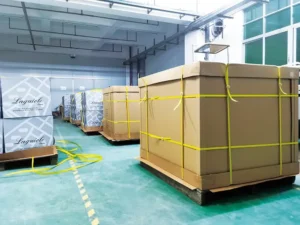
- Production Risk: Your materials have to survive the supply chain1. Imagine a full pallet of dog food bags. If the outer corrugated case isn't strong enough, the bottom layer will be crushed under the weight. This leads to unsellable, damaged goods and lost revenue. The choice between a folding carton and a stronger corrugated box is critical.
- Retail Risk: Retailers have strict standards. Your packaging might not meet their safety rules or material requirements (like using a certain percentage of recycled content). If it fails their standards, your product will never even reach the sales floor. We mitigate this by designing shelf-ready packaging6 (SRP) from the start. A corrugated tray with a clean, tear-away front allows staff to place an entire case of cat food on the shelf in seconds. It minimizes handling, reduces damage, and keeps your branding perfectly front-facing.
How Do You Prepare for Compliance, Testing, and Retail Approval?
You're ready to ship your first big order. Then you get a notice about a failed compliance test. Let's ensure your packaging passes every test the first time around.
Retail approval requires your product and its packaging to pass strict compliance, safety, and performance testing7 before it ever hits the shelf. Skipping this step can lead to costly delays and chargebacks8.

Every major retailer has a thick manual of packaging requirements. This isn't optional reading; it's the rulebook for getting your product into their stores. This stage is purely technical and non-negotiable.
- Design Risk: Simple labeling mistakes can be fatal. For pet food, the nutritional information and ingredient list must follow AAFCO guidelines. For a toy, you might need specific choke hazard warnings. Getting this wrong at the design phase means reprinting every single box, which is a massive expense.
- Production Risk: Your fully packaged product will undergo transit testing (ISTA tests)9, which includes drop tests, compression tests, and vibration simulations. If your corrugated box breaks open or the product inside is damaged, you fail. Production halts until you engineer a better packaging solution.
- Retail Risk: This is where the financial penalties appear. Retailers like Costco and Target have automated systems in their distribution centers. If your pallet is configured incorrectly or your barcode labels are in the wrong spot, their system will reject the shipment. You'll get hit with a chargeback—a fee for non-compliance—and your shipment will be sent back. We design with these rules in mind from day one. We know the exact compression strength needed for a pallet of dog treats to survive the journey to a Sam's Club warehouse, ensuring your product arrives safely and is accepted without issue.
How Do You Build a Scalable Packaging, Display, and Supply Chain System?
Your first store launch was a success! Now you have an order for 1,000 stores. Can your packaging and fulfillment process keep up? Let's build a system that's ready to scale.
Retail success depends on a system of packaging and displays that scales efficiently across regions, stores, and product variations. One-off designs create bottlenecks and inconsistencies that hurt your brand's growth.

Scaling from a few dozen local pet boutiques to 1,500 PetSmart locations is a huge operational challenge. The beautiful, hand-assembled display that worked for the boutiques is now a liability. You need a system built for volume.
- Design Risk: Designing a one-off solution is a trap. It might look great, but it's not repeatable. When a major retailer places a huge order, you can't afford to be figuring out manufacturing on the fly. You need a design that works for 10 stores and 10,000 stores.
- Production Risk: High unit cost at volume will kill your margins. If your packaging requires a lot of manual folding or assembly, your costs will explode as order volume increases. Smart, automation-friendly design is essential for profitable growth.
- Retail Risk: Inconsistent execution makes your brand look amateur. If you have different packaging and displays for every retailer, shoppers won't recognize you. Retailers will get frustrated with the lack of a simple, unified system. This is where we focus on modular systems10. We design a single, flat-packed corrugated floor display that can be adapted with different header cards or shelf inserts for various promotions or products. This keeps costs down, simplifies logistics (shipping flat is cheap), and ensures your brand looks professional and consistent everywhere it's sold.
How Do You Launch with the Right Retail Displays and In-Store Execution?
Your product is finally on the shelf. But it's hidden on the bottom row, gathering dust. Let's create a launch that grabs shoppers' attention and drives immediate sales.
The right Point-of-Purchase (POP) display11 turns a new pet product into a retail winner. It improves visibility, educates pet owners on your product's benefits, and drives powerful impulse sales.

Getting on the shelf is only half the battle. Now you have to get into the shopping cart. In a crowded pet aisle, a product without a display is practically invisible. An effective display is your 24/7 salesperson.
- Design Risk: The display must match the packaging and brand. If you have minimalist, premium packaging but your POP display is loud and cartoonish, you create brand confusion. The display must be a natural, attractive extension of your product.
- Production Risk: A flimsy display is worse than no display at all. A corrugated display that looks great in a 3D render can easily collapse in a busy store aisle if not engineered correctly. It must be durable enough to withstand shoppers and shopping carts.
- Retail Risk: Poor placement leads to zero sales. Even the best display is useless if it's stuck in a back corner. Retailers give premium placement, like endcaps12, to products that are easy for their staff to set up and are proven to drive sales. A complicated display that requires tools and a 20-page manual will end up in the stockroom. We design displays that demand attention and are incredibly easy to assemble. For a new line of dental chews, we can create a floor display with a giant tooth-shaped header and clear, benefit-driven messaging that a store employee can set up in under five minutes. This makes it easy for the retailer to say "yes" to putting you in a high-traffic spot.
New Pet Product Retail Readiness Risk Map13
| Step | Design Risk | Production Risk | Retail Risk |
|---|---|---|---|
| Positioning | Product name is confusing (e.g., "Pro-K9 Bites" - is it food, a treat, or a supplement?). | Packaging size is too large for the value-treats aisle, forcing costly redesigns. | Buyers at value-focused stores like Walmart reject it for being priced like a premium product. |
| Packaging Design | Using thin folding carton for heavy chew toys, leading to torn boxes on the shelf. | Glue on sealed pet food bags fails in humid conditions, causing spoilage and returns. | Petco rejects packaging that isn't made from at least 50% recycled material. |
| Compliance | Forgetting to add the "Not for human consumption" warning on cat treat packaging. | Ink used on packaging smudges during transit, making barcodes unscannable at the warehouse. | An entire shipment is rejected by Costco because the pallet height is 2 inches too tall for their racks. |
| Scaling | A complex box that requires manual folding becomes a production bottleneck for a 100,000-unit order. | Your single supplier for a custom-shaped plastic tub can't meet demand for a national rollout. | Inconsistent color printing across different production runs makes the brand look unprofessional on the shelf. |
| In-Store Launch | Display header card messaging is too small to be read from a distance in a busy aisle. | Corrugated display support struts are too weak and buckle under the product's weight. | Store staff can't figure out how to assemble the display, so it stays in the back room instead of on the floor. |
Conclusion
Retail readiness is a complete system, not just one step. Your packaging and displays are the critical gatekeepers to success. Pet brands that design for retail reality will scale faster.
Optimizing the supply chain ensures efficient distribution and reduces costs, supporting business growth. ↩
Clear positioning helps your product stand out to buyers and shoppers, making it more likely to secure shelf space. ↩
Defining these elements is crucial for securing shelf space in crowded pet aisles. ↩
Understanding planograms can help you design packaging that fits retailer requirements and secures shelf space. ↩
Balancing these elements ensures your packaging is effective in high-traffic retail environments. ↩
Meeting shelf-ready packaging requirements ensures your product is easy to stock and appealing to customers. ↩
Passing these tests is essential to avoid costly delays and ensure your product reaches the sales floor. ↩
Avoiding chargebacks is crucial to maintaining profitability and ensuring smooth retail operations. ↩
Transit testing ensures your packaging can withstand the supply chain, preventing damage and loss. ↩
Modular systems offer flexibility and cost-efficiency, making them ideal for scaling product distribution. ↩
An effective POP display can significantly increase product visibility and drive impulse sales. ↩
Endcaps offer premium placement, increasing product visibility and sales potential. ↩
Understanding this risk map can help you identify and mitigate potential risks in the retail readiness process. ↩