

Struggling to choose the right material for your retail displays? Picking the wrong one can cause your products to crash to the floor. Let me show you the safe choices.
A corrugated cardboard display uses corrugated cardboard laminated with coated paper. Large floor displays and dump bins use thick corrugated cardboard for strong weight-bearing.1 Small counter displays use lighter coated paper because they do not need to hold heavy products.

I remember the first time a client asked me about materials for a Walmart project. They were confused by all the industry terms. You might feel the same way right now. Let us break down everything you need to know so you can make the best choice for your next big-box retail rollout.
What is a cardboard display?
Want to sell small items at the checkout counter but lack space? A messy counter turns buyers away. A simple cardboard display solves this problem fast.
A cardboard display is a retail stand made mostly of thick coated paper.2 It is perfect for small counter displays. It does not have a wavy middle layer. We use it to hold lightweight items like lip balms or candy.

The Best Uses for Cardboard Displays
When brand managers ask me to design a display for a small space, I always look at cardboard first. We use solid coated paper for these projects. People also call this art paper. This material is very smooth. It takes print very well. Your brand colors will look bright and sharp on it.
However, this material cannot hold heavy weight. We only use it for small counter units. Think about the small boxes you see near the cash register at Target. They hold gift cards, small toys, or small makeup items.
I once designed a small cardboard unit for a new makeup brand. They wanted a cheap way to test retail sales. Cardboard was the perfect fit. It is easy to cut and easy to fold.
Here is a simple look at when to use basic cardboard:
| Feature | Details |
|---|---|
| Main Material | Coated paper |
| Best Location | Checkout counters, small shelves |
| Weight Capacity | Very light |
| Cost | Very low |
| Best Products | Cosmetics, candies, small accessories |
What is a corrugate display?
Do you need to hold heavy bottles of shampoo? Weak displays will break and ruin your products. A strong corrugate display will keep your goods safe.
A corrugate display is a strong retail structure made of corrugated cardboard. It has a wavy inside layer called a flute. We use this material for large floor displays, endcaps, and dump bins because it holds a lot of weight.

How Corrugate Displays Hold Heavy Loads
Corrugate is the workhorse of the retail world.3 If you want to put your products in Costco or Lowe's, you must use corrugated cardboard. The secret to its strength is its simple structure. It has a wavy paper layer sandwiched between two flat paper layers.
At Packwins, we do not just print on the brown box. We print your beautiful artwork on a sheet of coated paper first. Then, we laminate this printed paper onto the strong corrugated board. This gives you the best of both worlds. You get great looks and high strength.
I have built pallet displays that hold hundreds of pounds of dog food. Only corrugate can do this tough job.
Here is a breakdown of common corrugate display types:
| Display Type | Retail Location | Purpose |
|---|---|---|
| Floor Display | Aisle space | Holds medium to heavy goods |
| Endcap | End of an aisle | High traffic brand promotion |
| Dump Bin | Center store | Loose items on sale |
| Pallet Display | Club stores | Massive bulk item sales |
What are the differences between cardboard and corrugate?
Are you mixing up these two materials? Using the wrong term can lead to bad quotes and failed projects. Let us clear up the confusion right now.
The main difference is the wavy inner layer.4 Cardboard is a single, solid sheet of thick paper. Corrugate has three layers, including a wavy middle flute. Corrugate is thick and holds heavy weight. Cardboard is thin and only holds light items.

Making the Right Choice for Your Brand
Many people use the word "cardboard" for everything. But in our factory, they are very different things. You need to know the difference so you do not waste money.
Think about a cereal box. That is basic cardboard. Now think about the brown box that Amazon ships to your door. That is corrugate.
When a brand manager comes to me with a new product, I always ask about the weight first. If they sell heavy jars of sauce, we must use corrugate. If they sell light paper masks, we can use simple cardboard. Choosing the right one saves you money on shipping and production.
Here is a clear comparison to help you decide:
| Feature | Cardboard | Corrugate |
|---|---|---|
| Structure | Solid layer | Three or more layers |
| Strength | Low | High to very high |
| Best Display Size | Small | Large |
| Print Quality | Excellent | Excellent when laminated |
| Cost | Cheaper for small sizes | Costs more but holds more |
What are the flute choices for corrugate display?
Worried your display might bend under pressure? Picking the wrong flute size will cause disaster. You need the right flute to keep your display standing tall.
We use many flute types for corrugated displays.5 The most common single flutes are A, B, C, E, and F. For very heavy products, we combine them to make double wall boards. These include BC, EE, and BE flutes.

Understanding Flute Sizes and Strength
The flute is the wavy paper inside the board. The size of this wave changes how strong the board is.
For most standard floor displays in Walmart, we use a B flute.6 It offers a good mix of strength and a smooth surface for printing. If you have smaller boxes, we might use an E flute or an F flute. These are much thinner.
But what if you are going into Costco with heavy tools? We must use double wall boards. This means we glue two fluted layers together. A BC flute or a BE flute makes the display very stiff.7 I recall a project for a motor oil brand. A single flute collapsed in testing. We switched to a BC flute. It held up perfectly.
Here is a simple guide to flute choices:
| Flute Type | Thickness Level | Best Used For |
|---|---|---|
| E, F Flute | Very Thin | Small boxes, light counter units |
| B Flute | Medium | Standard floor displays, endcaps |
| C, A Flute | Thick | Shipping boxes, structural support |
| BE Flute | Double Wall | Heavy floor displays |
| BC Flute | Very Thick | Pallet displays, club store bins |
What are the GSM choices for cardboard display?
Is your small display tearing at the corners? Thin paper looks cheap and ruins your brand image. Selecting the right paper weight fixes this issue quickly.
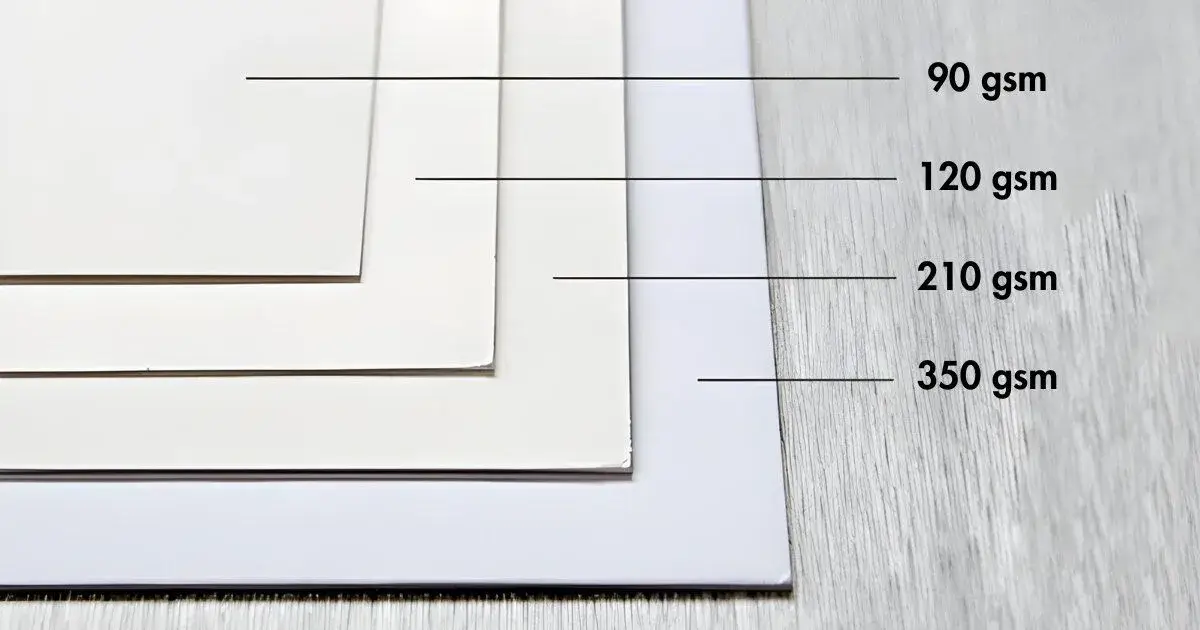
GSM stands for grams per square meter.8 It measures paper thickness. For small cardboard displays, we usually choose 250G, 300G, 400G, or 450G coated paper. A higher GSM means thicker, stronger paper for your retail stand.
How to Pick the Right Paper Weight
When we talk about solid cardboard or coated paper, we do not use flutes. We use GSM to talk about thickness.
If you choose 250G paper, it is like a very thick magazine cover. It is easy to fold. But it will not hold much weight. I usually tell clients to use 300G or 400G for counter displays. This thickness gives the display stiff walls. These walls will not bend when shoppers touch them.
If you want a very premium look, 450G is the best choice. It feels solid and expensive. I worked with a luxury skin care brand last year. We used 450G paper for their counter units. The thick paper made their products look much more valuable.
Here is how you can match GSM to your needs:
| GSM Choice | Thickness Feel | Best Use Case |
|---|---|---|
| 250G | Light | Simple headers, light folding boxes |
| 300G | Medium | Basic small counter trays |
| 400G | Heavy | Standard counter displays |
| 450G | Very Heavy | Premium counter units, heavy items |
Why retail displays boost sales at retail floor?
Are your products hiding on a crowded store shelf? If shoppers cannot see your brand, they will not buy it. A custom display puts your product first.
Retail displays boost sales by pulling products off crowded shelves.9 They put your items right in the shoppers' path. This grabs attention and triggers fast buys. Custom displays help new brands stand out in big stores like Walmart or Target.

The Power of Custom Retail Displays
Getting your product into a big-box store is only the first step. You still need people to buy it. Standard store shelves are full of competing brands. It is very hard to stand out there.
A custom corrugated display acts like a silent sales person.10 It tells your brand story with big and bright graphics. When we design a dump bin or an endcap, we make sure it stops the shopper in their tracks.
I have seen new brands double their sales just by moving from the main shelf to a floor display. Shoppers love to buy things on impulse.11 If your product is right in front of them, they will put it in their cart.
Here are the main reasons these displays work so well:
| Benefit | How It Works | Result for Your Brand |
|---|---|---|
| High Visibility | Stands in the aisle | More shoppers see your logo |
| Impulse Buying | Placed near registers | Fast and unplanned sales |
| Brand Story | Large print areas | Teaches shoppers about you |
| Easy Shopping | Products are easy to grab | Higher sales rate |
Conclusion
Choosing the right corrugated flutes and coated paper ensures your custom display succeeds.12 Strong materials protect your products and help boost your retail sales every time.
"[PDF] Investigating the mechanical properties of paperboard packaging ...", https://repository.rit.edu/cgi/viewcontent.cgi?article=1066&context=japr. This source explains the structural advantages of thick corrugated cardboard for weight-bearing applications in retail displays. Evidence role: mechanism; source type: education. Supports: Thick corrugated cardboard is used for large floor displays and dump bins because it can bear heavy weights.. ↩
"Benefits of Using Corrugated Cardboard for Custom Displays", https://www.creativedisplaysnow.com/benefits-cardboard-custom-displays/. This source defines cardboard displays and their typical material composition, focusing on coated paper. Evidence role: definition; source type: encyclopedia. Supports: Cardboard displays are retail stands made mostly of thick coated paper.. ↩
"Benefits of Corrugated Packaging for Retail - LinkedIn", https://www.linkedin.com/pulse/benefits-corrugated-packaging-retail-reedbut-limited-aaoxe. This source discusses the widespread use of corrugated cardboard in retail for its strength and versatility. Evidence role: general_support; source type: research. Supports: Corrugated cardboard is widely used in retail due to its strength and versatility.. Scope note: The source may not directly use the term 'workhorse' but will describe its extensive applications. ↩
"Corrugated fiberboard - Wikipedia", https://en.wikipedia.org/wiki/Corrugated_fiberboard. This source explains the structural differences between cardboard and corrugated cardboard, focusing on the wavy inner layer in corrugated materials. Evidence role: definition; source type: education. Supports: The main difference between cardboard and corrugated cardboard is the presence of a wavy inner layer in corrugated materials.. ↩
"Corrugated Box Flute Types Explained: A, B, C, E & F", https://www.onyxpackaging.com/blog/corrugated-box-flute-types.php. This source categorizes flute types used in corrugated cardboard and their applications in retail displays. Evidence role: definition; source type: education. Supports: Many flute types, such as A, B, C, E, and F, are used in corrugated displays for different purposes.. Scope note: The source may not cover all flute types but will provide a general overview. ↩
"Gaylord Archival® B-flute Corrugated Board Sheets (10-Pack)", https://www.gaylord.com/Preservation/Conservation-Supplies/Boards-%26-Paper/Gaylord-Archival%26%23174%3B-B-flute-Corrugated-Board-Sheets-%2810-Pack%29/p/HYB00953?srsltid=AfmBOoqf1rDJIPYI2kSHZBU3y-hLyhL6Ul5WeIwmrFMcDbfY_M9_X_43. This source discusses the suitability of B flute corrugated cardboard for standard floor displays in retail environments like Walmart. Evidence role: case_reference; source type: research. Supports: B flute is commonly used for standard floor displays in retail environments like Walmart.. Scope note: The source may not specifically mention Walmart but will discuss B flute's general applications. ↩
"Deciphering Double-Walled Corrugated Board Geometry Using ...", https://pmc.ncbi.nlm.nih.gov/articles/PMC10974599/. This source explains the structural advantages of BC and BE flutes in providing stiffness for heavy-duty retail displays. Evidence role: mechanism; source type: education. Supports: BC and BE flutes provide high stiffness for heavy-duty retail displays.. Scope note: The source may not cover all use cases but will discuss the general strength of BC and BE flutes. ↩
"Grammage - Wikipedia", https://en.wikipedia.org/wiki/Grammage. This source defines GSM as grams per square meter and explains its role in measuring paper thickness. Evidence role: definition; source type: encyclopedia. Supports: GSM stands for grams per square meter and is used to measure paper thickness.. ↩
"What's the Impact of Retail Displays on Sales Performance?", https://mcintyredisplays.com/blog/how-retail-displays-impact-sales/. This source examines how retail displays increase product visibility and sales by removing items from crowded shelves. Evidence role: mechanism; source type: research. Supports: Retail displays boost sales by increasing product visibility and reducing competition on crowded shelves.. Scope note: The source may focus on general retail environments rather than specific stores like Walmart or Target. ↩
"Do Custom Displays Increase Sales?", https://www.creativedisplaysnow.com/guides/how-custom-displays-increase-sales/. This source describes how custom corrugated displays enhance brand visibility and act as passive sales tools in retail. Evidence role: mechanism; source type: research. Supports: Custom corrugated displays enhance brand visibility and act as passive sales tools in retail.. Scope note: The source may not use the exact metaphor but will discuss the functional benefits of custom displays. ↩
"Factors Affecting Impulse Buying Behavior of Consumers - PMC - NIH", https://pmc.ncbi.nlm.nih.gov/articles/PMC8206473/. This source discusses the psychology of impulse buying and how retail displays can trigger such purchases. Evidence role: mechanism; source type: research. Supports: Retail displays can trigger impulse buying by placing products in high-visibility areas.. Scope note: The source may not directly link impulse buying to specific display types but will cover the general concept. ↩
"POP Display Design and the Importance of Material Selection- Part II", https://agilityretail.com/pop-display-design-and-the-importance-of-material-selection-part-ii/. This source explains how selecting appropriate materials like corrugated flutes and coated paper impacts the success of retail displays. Evidence role: mechanism; source type: education. Supports: Selecting the right corrugated flutes and coated paper is crucial for the success of custom retail displays.. Scope note: The source may not provide specific examples but will discuss general material selection principles. ↩


